
Nature as Teacher
Mind only knows what lies near the heart
It alone sees the depth of the soul
No worse ill assails the wise than to live without inner peace
This I learned waiting and crouched in the reeds
My body and my soul seemed wise to me
(Poetic Edda, Havamal 95 – 96)
The children are the future for the earth and indeed the future of humanity. The quote above shows how much contentment and understanding can be found whilst spending time in nature. Out there are various ways in which children and adults can learn and become part of nature. In a child’s case there is so much emphasis on academic learning that their place in the natural world as a holistic one is over-looked. There is so much stress and pressure in a young persons life, but learning does not need to be like this, it is only the creation of people who want to keep us downtrodden and become submissive to an artificial society.
There is pleasure in the pathless woods
There is rapture in the lonely shore
There is society where none intrudes
By the deep sea and music in its roar
I love not man less, but nature more
(Byron)
This page is not telling people to suck eggs, but shows how education in nature is having a bit of a renaissance. The outdoors is being rediscovered as a learning resource to show young people there is more to life than computer games and celebrity nonsense.
The environment has been a learning resource for thousands of years; the Druids used trees and their different qualities to produce the Ogham alphabet, as did the Norse, as each Rune has an associated tree.
Nature is ever changing through the yearly seasons with different ground flora in various states of growth and decay and re-growth. This can be used and watched throughout the year to help an individual understand the cycles of life.
There are ways of teaching to encourage being free in the environment without the constraints of a classroom allowing learners to explore and discover what else is in the world. Nature is dynamic and is ever changing with the seasons, light and shade, day and night, wet and dry, hot and cold.
Finding out what else lives in the environment encourages knowledge of other life existences. The textures, changing colours and the twisted features throughout the woods can enhance an individual’s creativeness using elements of the woodland for art, tool making, musical instruments or what ever they want to achieve.
The diagram below (and replicated from the intro) shows the main elements that impact on a person’s holistic development that research has shown to be particularly beneficial as a direct result of outdoor education.
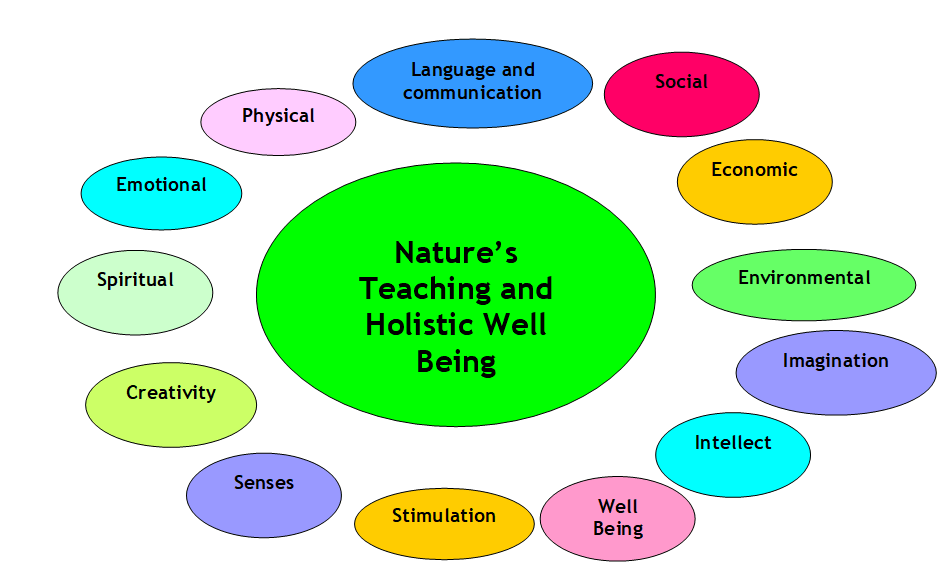
The diagram above shows the elements of development all are interlinked and interchangeable depending on a person’s individual learning pattern and needs. The circular distribution of the elements shows that learning is not necessarily linear, but one of increasing spirals depending on age and variety of experiences and one’s type of learning interest and pattern. The circular flow of the diagram above shows how the different elements are interconnected as part of a holistic entity which the learners are part of discovering themselves within the natural world. As is recognized by the popularity and success of Forest School as well Steiner and Montessori schools.
That was the education bit to encourage people to have a look at things, but there is also resurgence in planting and fertilizing by the moon phases and getting back to older varieties of cereals, such as spelt which are planted in spring rather than in winter.
It is never too late to start learning and discovering what nature is about and how to enjoy yourself and challenge yourself in the outdoors – The Animist Way of Being
 NatureRuna

Leave a comment